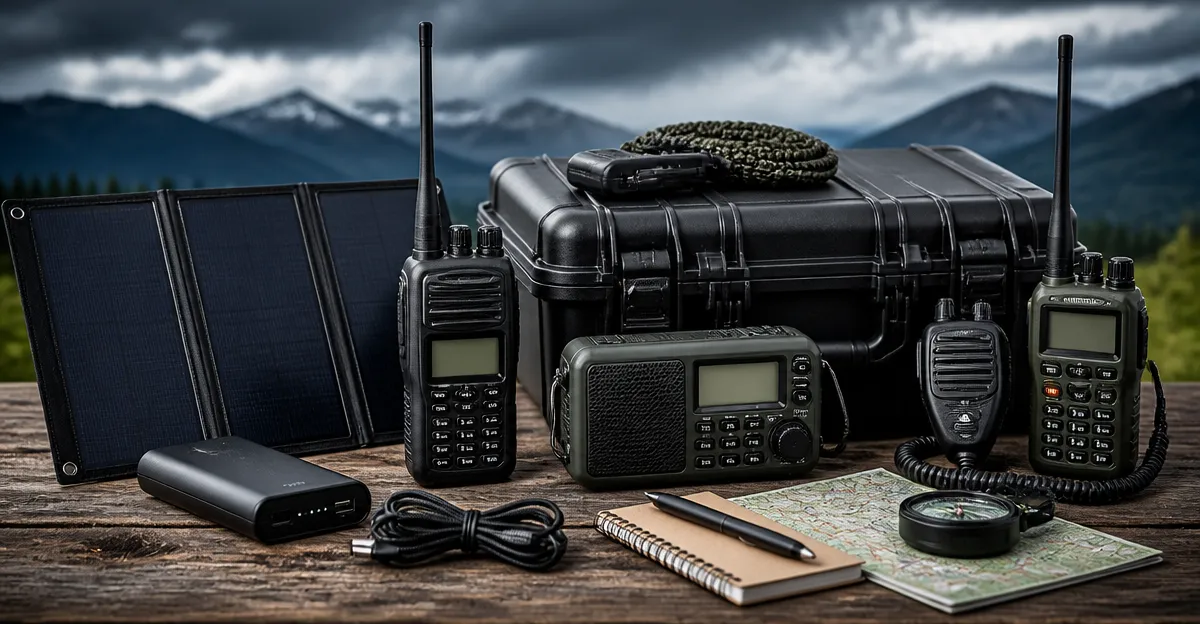
How to Build a Minimal EMP‑Resistant Communications Kit: Practical Guide for Preppers & Emergency Comms
Introduction
This guide explains how to assemble a lightweight, EMP‑resistant communications kit that can survive a high‑altitude electromagnetic pulse and keep you connected during prolonged outages. Readers will learn the essential concepts behind electromagnetic interference, the core hardware required, and how to select reliable products that meet strict performance criteria. The article also provides a side‑by‑side comparison of five top‑rated emergency radios and power devices, followed by actionable best‑practice tips. By the end of the guide, one will be able to construct a kit that balances durability, redundancy, and affordability.
Background / Context
An electromagnetic pulse (EMP) is a burst of electromagnetic energy that can overload electronic circuits, rendering many modern devices inoperable. EMP events may arise from solar flares, nuclear detonations at high altitude, or specialized weapons, and they typically affect unshielded electronics within a wide geographic area. To mitigate this risk, preppers focus on devices that are either intrinsically resistant to high voltage spikes or can be stored in protective containers such as Faraday cages. Communication remains the most critical capability after an EMP, because it enables coordination, access to emergency broadcasts, and the ability to call for assistance.
Key technical terms include Faraday cage (a conductive enclosure that blocks external electric fields), NOAA weather band (dedicated frequencies for weather alerts), and hand‑crank generator (a manual dynamo that produces electricity without external power). Understanding these concepts helps you evaluate whether a product truly offers EMP resilience or merely provides backup power for ordinary outages.
Understanding EMP Threats and Mitigation Strategies
EMP mitigation begins with three fundamental strategies: shielding, redundancy, and low‑tech reliability. Shielding involves placing sensitive electronics inside metal containers that are grounded and sealed, reducing the induced voltage from an EMP. Redundancy means having multiple, independent ways to generate and store power, such as solar panels, hand cranks, and battery banks. Low‑tech reliability refers to selecting devices that have simple circuitry, robust housings, and minimal reliance on micro‑processors that are vulnerable to voltage spikes.
When building a communications kit, prioritize radios that incorporate metal housings, external antenna ports, and manual power generation. Devices that combine solar panels with hand‑crank generators provide the greatest flexibility because they can harvest energy in daylight and generate power manually when sunlight is unavailable. The following sections detail each component category and recommend specific products that satisfy the EMP‑resilience criteria.
Core Components of an EMP‑Resistant Communications Kit
The essential elements of a minimal kit include a durable radio receiver, a multi‑source power solution, and auxiliary lighting for night‑time operations. Each component should be evaluated for power capacity, charging speed, reception quality, and ease of use under stress. The table below lists the five products examined in this guide, along with their most relevant specifications.
| Product | Power Capacity | Charging Options | Radio Bands | Rating |
|---|---|---|---|---|
| Mesqool Solar Hand Crank Radio | 12000 mAh | Solar, hand‑crank, USB, AAA | AM/FM/NOAA | 4.7/5 (991 reviews) |
| FosPower Emergency Weather Radio | 2000 mAh (7400 mWh) | Solar, hand‑crank, USB, AAA | AM/FM/NOAA | 4.6/5 (37,742 reviews) |
| Midland ER310 Emergency Radio | Battery (AA) dependent | Hand‑crank, USB, AA batteries | AM/FM/NOAA | 4.6/5 (5,960 reviews) |
| Raynic Solar Emergency Radio | Built‑in rechargeable (capacity not disclosed) | Solar, hand‑crank, USB, AC, 3 AAA | AM/FM/SW/NOAA | 4.5/5 (20,477 reviews) |
| RunningSnail Hand Crank Radio | 2000 mAh | Solar, hand‑crank, USB | AM/FM/NOAA | 4.5/5 (39,534 reviews) |
Power Solutions: Solar Panels, Hand Crank Generators, and Battery Banks
Power generation is the most vulnerable link in any EMP‑resistant kit because a depleted battery renders a radio useless. The Mesqool Solar Hand Crank Radio includes an 8500 mm² monocrystalline solar panel that is four times larger than typical panels, allowing faster charging even under low‑light conditions. Its high‑torque hand crank can fully charge the internal 12000 mAh battery in approximately three minutes, providing a rapid response when other sources are unavailable.
The FosPower Emergency Weather Radio features a 2000 mAh power bank capable of recharging small devices such as smartphones, while also offering a built‑in LED flashlight and SOS alarm. Although its solar panel is smaller, the combination of three power sources (solar, crank, AAA) ensures continuous operation.
For users who prefer a compact, ultra‑light option, the RunningSnail Hand Crank Radio provides a 2000 mAh battery and a three‑mode charging system. While its crank requires more effort than the Mesqool model, the unit weighs only 0.5 lb, making it ideal for backpacking or bug‑out scenarios.
All three devices can be stored inside a Faraday‑type container when not in use, preserving their internal circuitry from EMP exposure. When deploying, keep the solar panel exposed to direct sunlight and avoid shading, as even partial coverage reduces charging efficiency by up to 40 percent.
Radio Receivers: Frequency Coverage, Antenna Design, and Audio Quality
Effective communication after an EMP relies on the ability to receive NOAA weather alerts and AM/FM broadcasts that transmit critical emergency information. The Mesqool unit employs a high‑sensitivity signal chip, noise‑reduction circuitry, and an extended antenna that delivers clear reception across all three bands. Users have reported that the speaker produces crystal‑clear audio, making it suitable for both emergency alerts and casual music listening.
The Raynic Solar Emergency Radio expands coverage to shortwave (SW) and includes a large HD LCD display that shows frequency, battery level, and signal strength. Although the button layout may feel unconventional for some American users, the device’s multi‑band capability offers redundancy if local AM/FM stations are compromised.
The Midland ER310 Emergency Radio provides a rugged metal housing, an ultrasonic dog whistle for pet safety, and a dedicated SOS flashlight. Its reception is comparable to the Mesqool model, but it relies on AA batteries for primary power, which can be stored for years without degradation.
When selecting a receiver, prioritize models that feature external antenna ports, as a longer telescopic antenna improves signal capture during indoor use. Additionally, look for radios that include a dedicated weather‑scan mode that automatically switches to NOAA alerts when they are transmitted.
Integration and Redundancy: Building the Complete Kit
To achieve true EMP resilience, integrate the power and radio components into a single, portable package. One practical configuration is to place the Mesqool Solar Hand Crank Radio inside a lightweight Faraday pouch, alongside a separate 12000 mAh power bank for additional device charging. Include a compact solar panel (such as the one built into the Mesqool unit) and a manual crank handle that can be attached to a sturdy surface for extended charging sessions.
Supplement the main radio with the FosPower Emergency Weather Radio as a secondary receiver. Its dual‑light system (LED reading lamp and 1 W flashlight) provides illumination for night‑time operations, while its SOS alarm can attract rescuers.
Carry a small, waterproof storage bag that holds the RunningSnail Hand Crank Radio as a backup device. Its minimal size ensures it can be attached to a belt or placed in a vehicle glove compartment, guaranteeing access even if the primary kit is lost.
Finally, add a set of AA or AAA batteries, a universal USB‑C cable, and a basic antenna extension (e.g., a telescopic whip) to maximize flexibility. Regularly test the kit by simulating a power loss and verifying that each component functions as expected.
Comparison / Selection Guide
The following matrix helps readers decide which radio best matches their specific requirements. Consider factors such as power capacity, number of charging methods, band coverage, and price.
| Criteria | Mesqool Solar Hand Crank Radio | FosPower Emergency Weather Radio | Midland ER310 | Raynic Solar Emergency Radio | RunningSnail Hand Crank Radio |
|---|---|---|---|---|---|
| Price (USD) | 53.99 | 28.46 | 79.99 | 35.99 | 13.93 |
| Battery Capacity | 12000 mAh | 2000 mAh | AA (user‑supplied) | Not disclosed | 2000 mAh |
| Charging Options | Solar, hand‑crank, USB, AAA | Solar, hand‑crank, USB, AAA | Hand‑crank, USB, AA | Solar, hand‑crank, USB, AC, AAA | Solar, hand‑crank, USB |
| Radio Bands | AM/FM/NOAA | AM/FM/NOAA | AM/FM/NOAA | AM/FM/SW/NOAA | AM/FM/NOAA |
| LED Light | 260‑ft flashlight, reading lamp | 1 W flashlight, LED reading light | SOS flashlight | 3 W flashlight, 2.5 W reading lamp | 1 W flashlight |
| Rating | 4.7/5 (991) | 4.6/5 (37,742) | 4.6/5 (5,960) | 4.5/5 (20,477) | 4.5/5 (39,534) |
For users who require the longest runtime and multiple charging methods, the Mesqool model stands out despite its higher price. Budget‑conscious preppers may prefer the FosPower or RunningSnail radios, which still deliver reliable NOAA reception and hand‑crank capability. The Midland ER310 is ideal for those who value a rugged metal case and an integrated dog whistle for pet safety. The Raynic unit offers the broadest band coverage, including shortwave, which can be valuable for international travelers.
Best Practices & Tips
- Store all electronics in a Faraday container when not in use. A simple metal trash can with a tight‑fitting lid can serve as an effective shield.
- Perform monthly functional checks. Activate each radio, verify battery levels, and test the hand‑crank generator for smooth operation.
- Maintain a reserve of fresh alkaline batteries (AA or AAA) and keep them sealed in a waterproof bag. Batteries can provide immediate power if the internal battery fails.
- Label charging cables and connectors to avoid confusion during an emergency. Color‑coded tags reduce the time spent searching for the correct USB cable.
- Practice antenna deployment. Extend the telescopic antenna fully and experiment with positioning near windows or outdoor spaces to achieve optimal reception.
- Document emergency frequencies in a waterproof notebook. Include local NOAA channel numbers, community radio stations, and any private emergency nets.
- Rotate the solar panel orientation throughout the day to follow the sun’s trajectory, maximizing energy capture during prolonged outages.
Frequently Asked Questions
1. Will a hand‑crank radio survive a direct EMP blast?
Hand‑crank radios that use simple dynamo generators and metal housings are generally more resistant to EMP effects than devices with complex micro‑processors. However, to guarantee survivability, store the unit inside a Faraday enclosure until it is needed.
2. How long can a 12000 mAh battery power a radio?
Power consumption varies by usage, but the Mesqool radio typically draws around 100 mA while receiving AM/FM signals. At that rate, a fully charged 12000 mAh battery can operate the radio for approximately 120 hours (five days) of continuous listening.
3. Can I charge a smartphone with these radios?
Both the Mesqool and FosPower models include USB output ports capable of delivering up to 5 V/1 A, sufficient for trickle‑charging most smartphones. Charging speed will be slower than a wall charger, but it provides essential communication capability when grid power is unavailable.
4. What is the advantage of a solar panel over a hand crank?
Solar panels generate power without manual effort, allowing continuous charging during daylight hours. Hand cranks are valuable when sunlight is limited, such as during night or inclement weather, providing a reliable backup method.
5. Do I need a separate antenna for shortwave reception?
The Raynic Solar Emergency Radio includes an internal antenna that supports shortwave (SW) frequencies, but adding an external whip antenna can improve signal strength dramatically, especially in urban environments with high interference.
6. How often should I replace the internal batteries?
Lithium‑ion cells retain most of their capacity for 2‑3 years under normal storage conditions. It is advisable to fully charge the battery at least once every six months and replace it after three years of regular use.
7. Is there a risk of over‑charging the solar panel?
All five radios incorporate built‑in charge‑controller circuitry that prevents over‑charging. Nonetheless, disconnect the device once the indicator shows a full charge to extend battery lifespan.
Conclusion
Constructing a minimal EMP‑resistant communications kit requires thoughtful selection of power‑rich radios, redundant charging methods, and proper shielding. By following the strategies outlined in this guide, preppers can ensure continuous access to emergency broadcasts, maintain contact with loved ones, and preserve critical information during prolonged power loss. Regular maintenance, periodic testing, and proper storage are essential to keep the kit functional when it matters most.
Products Featured in This Guide
Mesqool Solar Hand Crank Radio
Price: $53.99 | Rating: 4.7/5 (991 reviews)
Featured for its 12000 mAh capacity, large high‑efficiency solar panel, and dual‑mode LED flashlight, making it a cornerstone of any EMP‑resistant kit.
FosPower Emergency Weather Radio
Price: $28.46 | Rating: 4.6/5 (37,742 reviews)
Featured for its built‑in 2000 mAh power bank, three independent charging sources, and robust LED lighting, offering excellent value for budget‑conscious preppers.
Midland ER310 Emergency Radio
Price: $79.99 | Rating: 4.6/5 (5,960 reviews)
Featured for its rugged metal construction, ultrasonic dog whistle, and multi‑power options, catering to users who prioritize durability and pet safety.
Raynic Solar Emergency Radio
Price: $35.99 | Rating: 4.5/5 (20,477 reviews)
Featured for its six‑way charging system, large HD LCD display, and inclusion of shortwave band, providing extensive versatility for outdoor enthusiasts.
RunningSnail Hand Crank Radio
Price: $13.93 | Rating: 4.5/5 (39,534 reviews)
Featured for its ultra‑affordable price, lightweight design, and three power sources, making it an excellent supplemental unit for secondary kits.