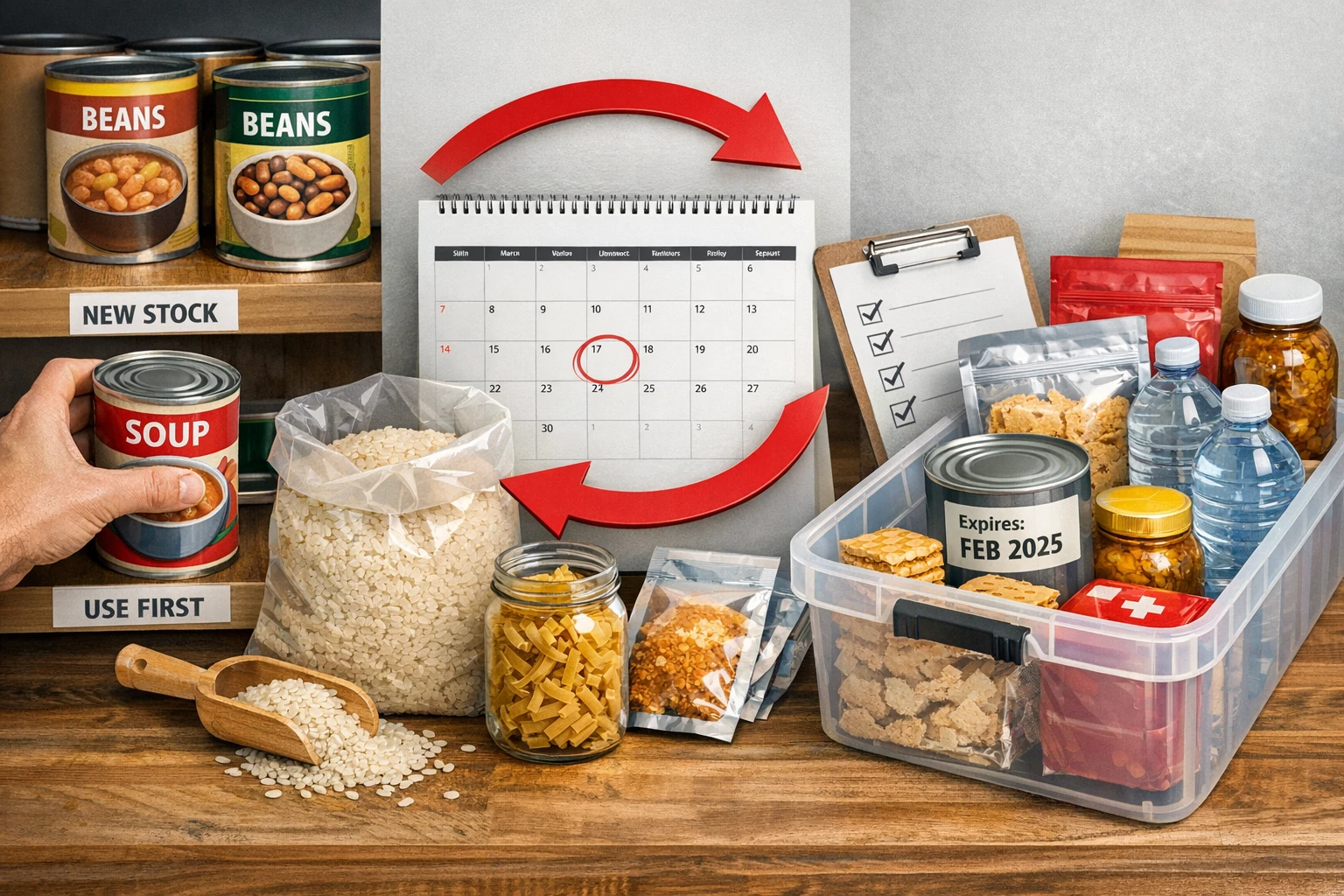
How to Rotate Emergency Food Supplies: Step‑by‑Step Guide to Extend Shelf Life, Prevent Waste, and Keep Your Stockpile Ready
Introduction
One must understand that emergency food is an investment in safety and peace of mind. This guide will teach the reader how to rotate supplies systematically, how to protect nutritional value, and how to avoid costly waste. By following the procedures, one will maintain a stockpile that remains ready for any unexpected event. The information presented is practical, evidence‑based, and suitable for individuals who already possess a modest emergency pantry.
What You’ll Need
- A reliable source of long‑term meals such as Survival Tabs Emergency Meal.
- Airtight storage containers – for example, CHEFSTORY Airtight Food Containers or Vtopmart Large Airtight Storage Set.
- Labeling system such as QSRProducts Day Labels.
- Permanent marker, notebook, and a calendar.
- Cleaning supplies (mild detergent, dry cloth).
Step 1: Assess Current Inventory
Begin by taking a complete inventory of all emergency food items. Record the product name, purchase date, expiration date, and the quantity stored. Use a spreadsheet or a notebook to create a clear visual map of the pantry. This assessment reveals which items are approaching the end of their shelf life and which can be used as rotation anchors.
During this process, one should verify that each package is intact, free of punctures, and stored in a cool, dry environment. If any package shows signs of damage, it must be removed immediately to prevent contamination of surrounding items.
For long‑term meals, the Survival Tabs Emergency Meal provides a compact, nutrient‑dense solution. Each bottle contains 180 chewable tablets that supply a full 15‑day emergency diet for one adult. The product is gluten‑free, non‑GMO, and boasts a 25‑year shelf life, making it an ideal benchmark for assessing other items.
Why this product is useful in this step: its clearly printed expiration date and consistent packaging simplify the inventory process, and its high rating (4.6/5 from 189 reviews) indicates reliable quality.
Step 2: Organize Using Airtight Containers
After the inventory, transfer loose items such as flour, rice, or powdered meals into airtight containers. This protects the food from moisture, pests, and oxygen, all of which accelerate degradation. Two container systems are recommended.
- CHEFSTORY Airtight Food Containers – an 8‑piece set offering four sizes (0.7 qt to 2.5 qt). The silicone gasket creates a four‑side lock that prevents air ingress. The set includes 24 reusable labels, which streamline the labeling stage. Price is $19.94 and the rating is 4.6/5 from 6,334 reviews.
- Vtopmart Large Airtight Storage Set – four 5.2 L containers with side‑locking lids, measuring cups, and 24 chalkboard labels. At $24.99 and a 4.6/5 rating from 31,716 reviews, this set is suited for bulk dry goods such as flour or sugar.
Choosing a container depends on the volume of the item. Smaller spices fit well in the CHEFSTORY set, while large staples benefit from the Vtopmart containers. Both options are BPA‑free, dishwasher‑safe (lids hand‑washed), and feature clear bodies for quick visual identification.
Why these products are useful in this step: they create a controlled environment that significantly extends the shelf life of dry foods, and the included labels reduce the need for additional purchases.
Step 3: Label Every Package with Rotation Dates
Accurate labeling is the cornerstone of an effective rotation system. Use the QSRProducts Day Labels to mark the date when each item is placed into storage. The stickers are removable, non‑smudge, and feature English, Spanish, and French day names, making them suitable for multilingual households.
Apply a label to the front of each container, noting the "stock date" and the "use‑by date". For example, write "Stocked 01‑Mar‑2024 – Use by 01‑Mar‑2029". The day‑dot design allows quick visual checks; the user can see at a glance which items require immediate consumption.
This product costs $29.99 and holds a 4.8/5 rating from 398 reviews, indicating high satisfaction with durability and ease of removal. Its removable nature prevents residue when the label is replaced during each rotation cycle.
Why this product is useful in this step: the non‑toxic adhesive ensures safety for food contact, while the removable tab simplifies updating labels without damaging containers.
Step 4: Implement a First‑In‑First‑Out (FIFO) System
Arrange the pantry so that the oldest items are positioned at the front of each shelf, and newer items are placed behind them. This physical layout enforces the FIFO principle without requiring constant mental tracking.
When adding new stock, place the fresh packages at the back of the container or shelf. Use the labels from Step 3 to confirm the correct order. For example, if a new bottle of Survival Tabs Emergency Meal arrives, store it behind the existing bottle and update the label on the front bottle to reflect its later expiration.
Regularly (monthly or quarterly) review the front items and plan meals that incorporate them. This practice prevents waste and ensures that the stockpile remains nutritionally balanced.
Why this method is effective: it leverages simple visual cues and eliminates the need for complex software, making it accessible to anyone with basic organizational skills.
Step 5: Schedule Routine Rotation Checks
Set a recurring calendar reminder to perform a rotation check at least once every three months. During each check, verify that all labels are legible, containers remain sealed, and no signs of moisture or pest activity are present.
If any item is within six months of its expiration date, plan to use it in upcoming meals and replace it with fresh stock. The replacement can be purchased using the same product recommendations to maintain consistency in quality and packaging.
Document each rotation event in a notebook or digital log, noting the items removed, consumed, or added. This record provides accountability and helps identify patterns, such as items that are consistently overlooked.
Why regular checks matter: they catch potential problems early, preserve the nutritional integrity of the supplies, and keep the overall system transparent.
Tips & Pro Tips
- Store the pantry in a location with a stable temperature between 50‑70°F (10‑21°C). Extreme heat accelerates vitamin degradation.
- Consider using a small dehumidifier in humid climates to maintain low moisture levels.
- For liquid emergency meals, keep them in their original sealed containers; do not transfer to other vessels.
- When labeling, use a permanent‑ink marker to prevent fading, especially on the CHEFSTORY containers where the surface is smooth.
- Rotate items during seasonal cooking; incorporate emergency meals into regular recipes to reduce waste.
Troubleshooting
Problem: Labels become unreadable after a few months.
Solution: Replace them with fresh QSRProducts Day Labels. Their non‑smudge surface is designed for long‑term use.
Problem: Containers develop a faint odor.
Solution: Wash the container with mild detergent, dry thoroughly, and reseal. If the odor persists, consider replacing the container with a new CHEFSTORY or Vtopmart unit.
Problem: Food appears clumped or moist.
Solution: Verify that the airtight seal is engaged correctly. Side‑locking lids must align perfectly; otherwise air can infiltrate.
Conclusion
By following the systematic approach outlined above, one can extend the shelf life of emergency food, eliminate waste, and maintain a stockpile that is always ready for use. The combination of accurate inventory, airtight storage, clear labeling, FIFO arrangement, and regular checks creates a resilient system. Implementing these practices today will provide confidence that the emergency pantry will perform reliably when it is needed most.
Products Mentioned in This Guide
Frequently Asked Questions
How often should I rotate my emergency food stockpile?
Rotate supplies every 6‑12 months, using the oldest items first and replacing them with fresh stock.
What is the best way to label rotating food items?
Use waterproof labels or a marker to note the purchase or expiration date and place them on the front of each container.
Do airtight containers really extend shelf life?
Yes, airtight containers protect food from moisture, oxygen, and pests, significantly slowing degradation.
Can I mix different types of emergency meals in the same rotation system?
Mixing is fine as long as each product’s specific storage guidelines are followed and items are labeled individually.
What temperature is ideal for storing emergency food?
Store food in a cool, dry place—ideally 50‑70 °F (10‑21 °C)—to maximize shelf life.